David Prosser: Ford gives digital radio a much-needed boost

Diposting oleh nangsa on Selasa, 29 Maret 2011

Outlook Don't get too excited, but fans of digital radio ought to extend a vote of thanks to Ford, which has just announced that all of its cars sold in the UK will come with DAB radios as standard by the end of 2012. That's a year ahead of the deadline the rest of the car industry has set.

It is an important move, given the continuing scepticism about whether it is really possible fordigital switchover to take place in 2015, as this Government, like its predecessor, hopes. The agreement is that digital radio must have at least a 50 per cent share of the audience before a decision is formally taken on when the switchover will take place – and that two years' notice will be given. For 2015 to be viable, therefore, today's audience penetration figure for DAB, which is 25 per cent according to the latest estimates, has to rise significantly in quite a short space of time.
Related articles

    * David Prosser: The long wait for better competition in British banking
    * Search the news archive for more stories

Car radio, where digital's share is currently just 3 per cent, is certainly an area where there is potential for a big contribution. But with the end of 2013 as the deadline for all new cars to come with digital radios as standard, the automotive sector is currently going to get the switchover campaign over the line in time for the Government to hit its target. An increase in the pace from Ford might help, though.

Not that we seem much closer to meeting some other challenges. The BBC continues to row with the commercial radio sector about who will pay for the roll-out of digital services. That is likely to see another criteria for switchover – that local digital radio is available to 90 per cent of the population – get in the way. Meanwhile, listeners continue to complain about the quality of the signal in many areas. And there is no sign of any incentives to persuade consumers buy digital sets, with a campaign for radio version of the scrappage scheme that boosted car sales during the recession stymied by the state of the public finances. If the radio industry really wants to encourage higher take-up – and it is the industry, rather than consumers, that has most to gain from switchover – it is going to have to finance such schemes itself.

The move from Ford is the first bit of good news the digital switchover movement has had for some time. But while the car-maker's initiative will be of some help, this is a road with plenty more bumps to come.
More aboutDavid Prosser: Ford gives digital radio a much-needed boost

Vita Audio R4i iPod Speaker Dock

Diposting oleh nangsa

http://news.ecoustics.com/bbs/messages/10381/676009.jpgVita Audio has announced the R4i integrated music system -- iPod speaker dock, CD player, DAB/DAB+ FM Radio with built-in subwoofer. The R4i will be available in a Limited Edition sparkling graphite high gloss lacquer with sliver hue grilles, in addition to rich walnut real wood veneer, high gloss midnight black and dream white finishes.

R4i incorporates a superior FM/DAB/DAB+ receiver with greater sensitivity on all bands together with the ability to receive higher definition DAB+ transmissions, which we believe will ultimately become the standard for terrestrial digital radio transmissions around the globe. Revised audio circuitry optimisation gives greater audio clarity and a new CD suspension arrangement provides improved tracking and shock resistance. These changes bring greater sound resolution and a sound-stage that belies the R4i's compact dimensions. Finally we've redesigned and upgraded R4i's power supply so it meets and exceeds forthcoming EU standby regulations.

Carefully crafted inside as well as out, R4i uses Vita Audio's hi-fi pedigree to produce stunning room-filling sound. Comprising a multi format CD player, iPod dock, USB playback port, DAB, DAB+ and FM tuner and auxiliary inputs combined to a powerful 80-watt audiophile-grade amplifier and speaker system.R4i Features

    * Slot loading CD player plays CD-Audio, MP3 and WMA music disks
    * Integrated iPod Dock supports and charges all models produced from January 2004 onwards.
    * USB port for playback of MP3 and WMA music files
    * DAB, DAB+ and FM Tuner with RDS
    * 80-watts nominal power output
    * Integrated active subwoofer
    * Intuitive docking Vita Audio 'RotoDial' provides remote control of all R4i and iPod functions
    * Two switchable auxiliary inputs for playback of other audio devices or streaming devices such as Bluetooth receiver or Apple AirPort Express
    * 3D enhanced stereo sound
    * Information support for MP3 files on CD and USB
    * Selectable tone settings
    * Stereo headphone output
    * Dimensions: (H) 145 x (W) 450 x (D) 255mm
    * Weight: 8Kg
    * SRP UK: £629.99 -- Sparkling Graphite piano lacquer

Availability
Vita Audio products are available only through selected outlets. These include John Lewis, Selfridges, Harrods, House of Fraser, The Conran Shop and a range of quality specialist audio and design stores. The R4i will be available May 2011. The original R4 first released in 2008 is available at Amazon UK.
More aboutVita Audio R4i iPod Speaker Dock

Panasonic TX-P42GT30B 3D Plasma TV Review

Diposting oleh nangsa on Senin, 28 Maret 2011

The Panasonic TX-P42GT30B is the company’s mid-range 3D Plasma TV for 2011, featuring the 14th generation NeoPlasma (formerly “NeoPDP”) panel with “Infinite Black Pro”, Short-Stroke phosphor material for reduced trailing and 3D crosstalk, and a newly redesigned ultra-slim chassis. The TX-P42GT30B has also been through the THX Display Certification programme for 2D viewing, and new for 2011, for 3D viewing as well. Last year’s Panasonic Plasma displays needed quite a bit of calibration work in order to avoid unwanted colour tints when playing back 3D video, and actually doing this calibration through the 3D Active Shutter glasses required expensive specialised equipment. Hopefully, THX’s certification process will allow all users to watch tint-free 3-dimensional images without the need for extensive picture setup.
Of course, for further picture fine-tuning, the Imaging Science Foundation (ISF) controls are still present, and have been expanded slightly this year. Panasonic’s midrange Viera HDTVs have typically produced excellent picture quality at very reasonable prices, so if the GT30 performs well, then it should be one of the main Plasma televisions to beat this year. Let’s find out how it performs!

Design

Although we feel that design isn’t terribly important in the scheme of things, there’s no denying that Panasonic has upped the ante this year. Although we had a look at these HDTV displays at February’s Panasonic convention, we didn’t really acknowledge the improvement until we got a review sample into our test room.
Panasonic TX-P42GT30B
The design of the Panasonic TX-P42GT30B is considerably improved compared to the Viera G20 and GT20 displays that it replaces: it’s thinner, and more subtle and professional looking. The thin border surrounding the sleek-looking glass panel is styled with a brushed steel look, which makes the TX-P42GT30 feel like a smaller version of Panasonic’s professional Plasma displays (which we’ve always envied the design of). The outer edges of the plasma are rounded rather than being square, and there is a small silver border placed between the screen itself and the outer bezel.
In fact, the promotional images Panasonic has issued do the TXP42GT30 a disservice. In pre-rendered publicity pictures, the display looks pretty much the same as every other gloss black TV out there. Don’t judge the GT30’s looks until you see it in the flesh. Less practically, the TX-P42GT30B’s thickness has also been reduced to a mere 3cm (for most of the back panel – the deepest point, at the bottom of the unit, is closer to 5cm).
GT30 design
Build quality is also top-notch: no part of the TX-P42GT30B feels cheap or plasticky. It’s probably worthwhile pointing out that the TXP42GT30 does not ship with any 3D glasses, so they will have to be purchased separately if the owner intends to watch extra-dimensional content.
Although we spotted a newly revised remote control design at the company’s annual convention last month, it seems that it’s reserved for high end models only. The mid-range GT30 features a familiar Panasonic remote control, albeit styled in silver. We like this design and have no real issues with it, so aren’t really disappointed – although it looks a little plain when compared to the 3DTV itself. There is now a dedicated “3D” button on the remote control, which is a most welcome addition for European models. Strangely, although the Panasonic TX-P42GT30 features the new “VIERA Connect” online service, the remote control button used to access it still reads “VIERA Cast”. Oops?

Connections

The TX-P42GT30B’s design means that, like other manufacturers who have produced ultra-slim displays, Panasonic has had to incorporate the majority of the TV’s video inputs via break-out adapter cables. The exception to this rule is the 4 HDMI inputs, which are slim enough to be built directly in to the back panel. These are mounted facing side-ways to the rear left of the TXP42GT30. Since the HDMI inputs are located quite close to the edge of the rear panel, we found that they would sometimes stick out and remain visible from the front viewing position. Inexpensive L-shaped HDMI adapters or cables could solve this problem, should it become an issue.
Rear connections on Panasonic TX-P42GT30B
Rear: 4 x HDMI, SCART, Component, aerial, Freesat, ethernet & audio outs
As for other connectivity options, there’s one RGB SCART input, one Component input, and a nearly useless Composite video input. It seems that the analogue RGB (PC “VGA”) input has been lost in the slimming-down process, but given that most computers can now output via HDMI, we don’t see this as too big an issue.
There are also feeds for the dual tuners on the Panasonic TX-P42GT30B. These are located facing down quite near the bottom of the display, and at first, we were a little wary of forcing the breakout adapter cables into the ports, in case we damaged something. A little force is needed to attach the short extension cables into the tuner inputs, and from there, the appropriate connections can be made.

Operation

Panasonic has given most of its lineup a refreshing new menu redesign for 2011. The menus are now drawn in sleek transparent grey, which matches the design of the GT30 itself quite nicely. Some of the menu options have been re-arranged so as to appear in more logical positions: for example, the [3D Settings] screen is now accessed from the [Picture] menu, rather than from a generalised Setup menu. Additionally, with the two “Professional” picture modes, the settings are now accompanied by visible numbers, which is new for the UK variant models and is helpful during the process of finding the best picture settings (which we’ll do in the “Calibration” section).
[Picture] menu
[Picture] menu
[Picture] menus
The [Colour Management] menus introduced last year have been expanded to also include control over the Luminance (Brightness) of the colours, adding the final level of control in addition to the existing adjustments for Saturation and Hue. With last year’s Panasonic flat-screen TVs, we found that even without control over Luminance, there were no huge errors anyway, but more control is always welcome. There are still no adjustments for secondary colours, but we’ll find out later if that’s a big problem or not (our guess is not).
Panasonic has also added Film Cadence Detection to its Plasma televisions this year. On the UK models, this option is called “Clear Cinema”. We’ll find out how well this works later on in the review. Two options to help prevent, or to alleviate Plasma display Image Retention, are also helpfully placed in the picture menu. We’re glad to see an easy shortcut to the “White Scrolling Bar” pattern being made available to users – it’s been present on Panasonic Plasma displays for some time now, but hidden away in the service menu. If you do have a marathon session of TV viewing from a channel with a particularly garish fixed on-screen logo and find it lurking around afterwards, then this “screen wipe” should sort things out.

2D Calibration

Note: Our Panasonic TX-P42GT30B review sample was calibrated using Calman Professional, the industry-leading video calibration software.

2D Mode Greyscale

Pre-calibration RGB Tracking
Pre-calibration RGB tracking and delta errors (dEs)
We allowed our TX-P42GT30B to age for a few days, and then recorded the above measurements from its “THX” picture mode. The image on our TX-P42GT30 review unit had a slight excess of green in the picture, but as we usually find from THX-certified displays, the errors were negligible.
Post-calibration RGB Tracking in [Professional1] mode
Post-calibration RGB tracking and dEs in [Professional1] mode
Cleaning up Greyscale tracking didn’t take long at all, and we were left with the above, highly linear result. We could mention that other HDTV manufacturers are introducing 10-point control (LG has it even on bargain-priced models), but given the quality of the above result, it hardly seems worth mentioning: all stimulus levels except for 10% have a Delta Error of about 2 or less, meaning that the picture will appear free of unwanted tints.
Panasonic’s calibration menus have been improved this year. The on-screen slider control now appears fixed at the bottom of the screen, which is an improvement over last year’s models. On the 2010 displays, the on-screen graphics sometimes covered up the area of the screen that was being read, obviously skewing the measurements. Secondly, the low-end controls seem to have much more scope for adjustment this year: they are much less coarse.
Gamma curve in [Professional1] mode Gamma tracking in [Professional1] mode
Gamma curve in [Professional1] mode Corresponding gamma tracking
Gamma tracking has never been consistent on any of the Panasonic Plasma TV sets we’ve reviewed. Measurements are strongly influenced by the test patterns being used to gather measurements (compare measurements taken with standard windows compared to smaller patches, for example), indicating some degree of unpredictability as to real-world performance. The above measurements were taken using the small APL windows from the AVSHD calibration disc with the TX-P42GT30’s [Gamma] setting set to “2.2″. As the “Gamma Y” chart indicates, under these conditions, the Panasonic TX-P42GT30B rose out of black slightly too abruptly, over-emphasising shadow detail. As is often the case with Gamma, the user would likely require a perfect “broadcast quality” display (or intimate knowledge of material as viewed on one) to notice any issues.

2D Mode Colour

Although there are still no dedicated controls over the secondary colours (Cyan, Magenta and Yellow), Panasonic has added three-axis control over the Primary colours this year. In other words, we can adjust the Hue and Saturation of Red, Green and Blue (top chart) and new for 2011, also the Luminance of each primary colour, too (bottom chart). The results speak for themselves – although the out-of-the-box performance was very good, the excellent level of control allowed for any colour errors to be further minimised.
Post-calibration CIE chart in [Professional1] mode
Post-calibration CIE chart with reference to HD Rec.709
Post-calibration Luminance levels in [Professional1] mode
Post-calibration colour luminance (coloured bars = targets; black bars = measured values)

3D Calibration

Panasonic Plasma TVs haven’t had any obvious Greyscale or Colour errors for a while now, so the above results from 2D calibration really weren’t surprising. With 3D, however, it’s a different story. Last year’s first-generation 3D TVs produced a 3D image that was incredibly red-tinted out of the box. Correcting this required a non-contact calibration meter, specialised software, and a good amount of patience – and even then, the post-calibration image wasn’t entirely free of colour tints. Since the TX-P42GT30B has gone through the THX Certification process for both 2D and 3D images, we were enthusiastic to test this 2011 plasma’s out-of-the-box 3D performance.
Even before we began calibrating, we noticed an improvement: the Panasonic GT30 features discrete picture settings for both the 2D and 3D display modes. This is important, because 2D and 3D require different picture settings to both look their best. In other words, make a change to the “Professional1″ mode in 3D, switch back to 2D, and you’ll find that your 2D settings have been preserved and the change has only affected the 3D mode. This also means that users no longer have to re-purpose the “Professional2″ mode for 3D picture settings and manually change the picture mode upon entering or leaving 3D.
More aboutPanasonic TX-P42GT30B 3D Plasma TV Review

The comedian tests the iPod dock with serious hi-fi ambitions

Diposting oleh nangsa

The real beauty of the Fatman Carbon Trinity valve dock is simplicity. Just plug in the iPod and off you go. You can stick a party playlist in the dock and you've got nothing to worry about all night
I am not a total audiophile, obsessed with gold cables and the sound supremacy of vinyl.

For me, there’s an obvious compromise: what you lose in audio quality is more than made up for by the fact that you can have a matchbox-sized device that carries your entire music library. But even a layman such as myself can appreciate the difference a high-quality valve amplifier can make.

So it’s great to see a traditional valve system that’s dedicated to the iPod. A few years ago, if you wanted a decent hi-fi system, you had to mess around with cables and inputs, not to mention the fact that most high-end hi-fi treated iPod connectivity as an afterthought. But the Fatman Carbon Trinity valve dock (£300, play.com) is tailored to the iPod in a brilliant mix of old and new.

The valves give it a wonderfully smooth, warm sound that I completely loved – so much so that I immediately went out and bought a subwoofer to go with it.

I’m into all kinds of music. Recently I’ve been listening to Stray Cats, Jojo Mayer, Led Zeppelin, The Cramps and Dave Brubeck. To give the Fatman a good workout, I listened to almost every conceivable genre – and it didn’t really come unstuck anywhere.

Occasionally, I wished it was a bit rougher round the edges – it’s a very civilised amp – and sometimes it could benefit from a bit more bite. But that’s not to say it lacks power. You can turn it up really loud and make the house shake, without much sound distortion.

The real beauty of the Fatman is simplicity. There’s no fiddling or faffing; just plug in the iPod and off you go. Nothing beats the fact that you can stick a party playlist in the dock and you’ve got nothing to worry about all night.
The real beauty of the Fatman Carbon Trinity valve dock is simplicity. Just plug in the iPod and off you go. You can stick a party playlist in the dock and you've got nothing to worry about all night

The real beauty of the Fatman Carbon Trinity valve dock is simplicity. Just plug in the iPod and off you go. You can stick a party playlist in the dock and you've got nothing to worry about all night

And you don’t even need to use the dock itself: I’ve got Apple’s Airplay set up at home, which means I can stream music through the house with  little wireless substations, one of which I’ve plugged into the Fatman’s USB socket.

Airplay is absolutely marvellous when it works and profoundly frustrating when it doesn’t, which luckily is only once in a while.

Essentially, if like me your entire music collection has now been converted into digital form but you still want to squeeze top-quality sound out of it, one of these cool-looking docks is the ideal solution
More aboutThe comedian tests the iPod dock with serious hi-fi ambitions

The iPod has changed the way we listen to music. And the way we respond to it.

Diposting oleh nangsa

Two years ago, at the nadir of the financial crisis, the urban sociologist Sudhir Venkatesh wondered aloud in the New York Times why no mass protests had arisen against what was clearly a criminal coup by the banks. Where were the pitchforks, the tar, the feathers? Where, more importantly, were the crowds? Venkatesh's answer was the iPod: "In public spaces, serendipitous interaction is needed to create the 'mob mentality.' Most iPod-like devices separate citizens from one another; you can't join someone in a movement if you can't hear the participants. Congrats Mr. Jobs for impeding social change." Venkatesh's suggestion was glib, tossed off—yet it was also a rare reminder, from the quasi-left, of how urban life has been changed by recording technologies.
The concern that recorded music promotes solipsism and isolation isn't new. Before the invention of the record and the gramophone (1887), the only form of listening people knew was social; the closest thing to a private musical experience was playing an instrument for yourself, or silently looking over a score. More often, if you had the means, you got to sit in the panopticon of the concert hall, seeing and being seen to the accompaniment of Verdi—an experience most fully described by Edith Wharton in the opening scene of The Age of Innocence (1920), just as it was going out of style. With mechanical reproduction came the hitherto unimaginable phenomenon of listening to multi-instrumental music by yourself. How, a contributor to Gramophone magazine asked in 1923, would you react if you stumbled upon somebody in the midst of this private rapture? It would be "as if you had discovered your friend sniffing cocaine, emptying a bottle of whisky, or plaiting straws in his hair. People, we think, should not do things 'to themselves,' however much they may enjoy doing them in company."

But it wasn't only solitary hyper-listening that recording facilitated. By 1960, recorded popular music had begun, in mysterious ways, to promote new social movements. Former Black Panther Bobby Seale recounts in his memoir how Huey Newton developed an elaborate reading of Dylan's "Ballad of a Thin Man" as an allegory of race: "This song Bobby Dylan was singing became a very big part of that whole publishing operation of the Black Panther paper. And in the background, while we were putting this paper out, this record came up and I guess a number of papers were published, and many times we would play that record." The song wasn't overtly political but its mood of stately menace seems to have insinuated itself into the politics of the Panthers.
Advertisement

The '60s were a decade of both mass protests and mass concerts, and this was more than a coincidence. Barbara Ehrenreich has suggested that the roots of second-wave feminism could be found in the tens of thousands of shrieking girls who filled arenas and ballparks at the Beatles' American stops, from the Hollywood Bowl to Shea. These girls, unladylike, insistent, were going to scream for what they wanted. Social change drove musical experimentation, and—more remarkably—vice versa.

The music of this era was—it's worth repeating—an incitement to social change. It was the sound of not going reflexively to war, of mingling across class and racial lines, of thinking it might be all right to sleep around a little, of wanting to work a job that didn't suck.

Of course the radical hopes of the '60s collapsed. The highest-rated YouTube comment on a video of Joan Baez singing "We Shall Overcome" manages to be both smug and glum: "Though we obviously failed, I am so glad that I am of a generation that believed we could make a difference." By the early '70s, popular music had more or less forfeited its capacity to promote social movements. From then on its different varieties would be associated with defining lifestyle niches, consumer habits, and subcultural affiliations. In this way the make-it-new modernist imperative, which seized pop music several decades late, came to seem little different from the program of advertisers launching fresh product lines. Jadedness swept pop music enthusiasts, many of whom, heartbroken by their brief glimpse of collective life, would discount the whole era of the '60s as history's cunning preparation for a descent into hellish consumerism. Welcome to dystopia, a counterfeit heaven where music plays all the time.

***

The first to ring the alarm about the omnipresence of recorded music were classical music snobs who, as part of their contracted duties as university professors, had to spend time on college campuses. "This is being written in a study in a college of one of the great American universities," wrote George Steiner in 1974. "The walls are throbbing gently to the beat of music coming from one near and several more distant amplifiers. The walls quiver to the ear or to the touch roughly eighteen hours per day, sometimes twenty-four." Allan Bloom picked up the beat in The Closing of the American Mind (1987): "Though students do not have books, they most emphatically do have music. …. Nothing is more singular about this generation than its addiction to music." Steiner: "It matters little whether it is that of pop, folk or rock. What counts is the all-pervasive pulsation, morning to night and into night, made indiscriminate by the cool burn of electronic timbre." The only historical analogy Bloom could think of was to the Wagner cult of the late 19th century. Yet even world-conquering Wagner appealed to a limited class, who could only hear his works in opera houses. By contrast the music of the late-20th-century world was truly ubiquitous. Steiner: "When a young man walks down a street in Vladivostok or Cincinnati with his transistor blaring, when a car passes with its radio on at full blast, the resulting sound-capsule encloses the individual." Bloom: "There is the stereo in the home, in the car; there are concerts; there are music videos, with special channels devoted to them, on the air, nonstop; there are the Walkmans so that no place—not public transportation, not the library—prevents students from communing with the Muse, even while studying." Steiner: "What tissues of sensibility are being numbed or exacerbated?"

Yadda, yadda. Yet Bloom and Steiner were right! In fact they had no idea how right they would become. If the spread of home stereo equipment in the 1970s, followed by that of portable devices (the boom box, the Walkman, briefly the Discman), brought music to the masses in a new way, digitization and the iPod have made recorded music even more plentiful and ubiquitous. The fears in Bloom's time that cassette tapes would bring down the music industry are quaint now, in the face of trillions of bytes of music traded brazenly over the Internet every minute. So, too, does the disc mania of record collectors pale in the face of digital collections measured in weeks of music. A DJ's crate of 100 LPs amounts to about three days of straight listening; your standard 60-gigabyte iPod, 50 days. Has anyone these days listened to all of their music, even once through?
More aboutThe iPod has changed the way we listen to music. And the way we respond to it.

Hands-on review: Enercell Portable Power Bank for iPod, iPhone

Diposting oleh nangsa

Radio Shack set up shop at Pepcom at CTIA Wireless 2011 this year, toting along several cell phone power packs from its Enercell line. Here’s a hands-on review of the Enercell Portable Power Bank for the iPod and the iPhone.

SET-UP

There isn’t really much of a set-up process for a gadget accessory like this. The Enercell comes with a charge of about 75% straight out of the box, so all one has to do is plug in the iOS device and the green LED lights should shine. (If it’s not charged up, just plug in the built-in USB cable to a computer or plug.)

And while this isn’t entirely important, bonus points for the packaging design that simply clicks open. Everyone hates the plastic packaging around electronics that are so difficult to open and always seem to incur cuts on one’s hands.

USE

The Enercell Portable Power Bank is a very compact gadget that provides just about double the amount of power that the iPhone or iPod already has. Radio Shack reps promised six to eight hours of extra juice from the 1,800 mAh battery, and that’s basically what I got. So if you plug in your iOS device into the wall every night, then you’ll only have to do it every other night if using the Enercell bank in its place.

One minor problem I had with the Portable Power Bank was that it does not latch onto the iPhone very well (and likely iPod, although I only used an iPhone 4 with this accessory). Yes, there is a 30-pin connector port, but it only stays attached when flat. I had to hold it together to make sure the battery is charging initially. I didn’t have to hold the Enercell battery and the iPhone together the entire time, but any slight movement, and the iPhone stopped charging from the external battery.

Thus, this is better for charging overnight or when you can leave the iOS device alone for along time, but not while operating the device or on-the-go. So don’t confuse the Portable Power Bank for a docking station, even though it looks quite similar at first glance to Kensington’s PowerLift battery and dock.

AVAILABILITY

The Enercell Portable Power Bank is available now for $39.99.
More aboutHands-on review: Enercell Portable Power Bank for iPod, iPhone

Corsair SP2200 2.1 Speaker System Review

Diposting oleh nangsa on Sabtu, 26 Maret 2011

You’ve probably seen its krazy-kool neon and graffiti-splattered cans stacked up for sale in mall kiosks, or clamped to the dome of some young’n on a skateboard as he whisks by and spills your latte all over your Haggar slacks.

The company’s demo skews young, and we all know the kids don’t necessarily care if their music sounds good, as long as it’s loud. Needless to say, Skullcandy’s headphones haven’t ever scored high marks among audiophiles. Being one of these snobbish elites, my expectations were not inflated when I received a shipment of Roc Nation Aviators, a set of headphones cross-branded with Jay-Z and LiveNation’s Roc Nation promotions outfit.

Skullcandy is angling the $150 set as its first foray into audiophile territory. It’s a shrewd move. All those tweens who grew up on Skullcandy cans are now graduating to adulthood, collecting their first real paychecks and looking to upgrade all the little things in their lives. And maybe they’ve outgrown the desire to wear bright pink skulls on their ears.

The Aviators’ styling is unique and fashionable, but not garish. True to the name, they’re reminiscent of the iconic aviator sunglasses. They have see-through plastic over-the-ear cups, leather pads, suede headband, nylon cord and chrome accents along the edges. Three colors are available: white, black and brown/gold.

So, they’re not ugly. That’s a plus, I thought. But then I put them on and — wait a minute, these actually sound pretty good. Not amazing, but much better than anything else I’ve heard from Skullcandy thus far.

The Aviators can get a little abrasive at times, especially when you’re listening to modern rock or techno. And the bass isn’t as present as I’d like it to be. Hip-hop sounds oddly tinny. But put on some mellower stuff that hasn’t been amped up to appeal to today’s ADHD standards — Nina Simone, Cat Power, James Blake, singer-songwriter stuff, classic rock — and the Aviators impress. My headphone nerd friends were all curious, so we passed them around and everyone agreed: solid.

They perform particularly well in quieter settings. Walking around on the street or riding on a city bus, I found the thin plastic shell didn’t do the best job of blocking out exterior noise. But indoors, in the park or at my desk, they were comfortable to listen to — and to wear — for long stretches.

There’s a remote with a built-in mic on the cord, so you can talk on the phone, change the volume, pause the song and skip tracks. The connector fits the iPhone (with a bumper, even) and all the Android phones I tried.

There’s also a companion app for the iPhone, iPad and Android. Version 2 of the Skullcandy App was just released earlier this month, so I tried it out. It has a library of streaming music that fits the “brand lifestyle” — lots of great West Coast hip-hop and some atrocious Sublime-wanna-be ska-punk — as well as streaming videos of skaters, surfers and snowboarders getting rad. The design is tidy. One cool feature: a map that shows the locations of local skateparks, ski resorts and surf spots, complete with current conditions.

But back to the Aviators. They’re not bad at all, even if they are a little steep. At $150, you can certainly buy a better set of over-the-ear cans. I won’t be trading these for my ATH-M50s or my Shure SRH750 DJ headphones, both of which are in the same price range and out-perform the Skullcandies. But while those are giant Cadillacs, these Aviators are more like a spry Miata. They fold up for travel, they’re comfortable and extremely light, and they come with a handsome leather case. So if you need a set of over-the-ear headphones that can squeeze into a fanny pack, the Aviators are a good choice.
More aboutCorsair SP2200 2.1 Speaker System Review

Deal of the Day: Logitech X-540 5.1 Surround Speaker System - $51.41 Shipped!

Diposting oleh nangsa

Deal of the Day: Logitech X-540 5.1 Surround Speaker System - $51.41 Shipped!


Our Deal of the Day today is the Logitech - Dented Box Special - Logitech X-540 5.1 Surround Speaker System - $51.41 Shipped!.

Offer: Great price on this dented box special from Logitech. Get the Logitech X-540 5.1 speaker system for just $41.99 + $9.42 shipping. There are some features I love about the X-540 like the LCD monitor clip so you can mount the center speaker to your monitor, a control pod w/ headphone jack, and matrix mode to transform older 2-channel sounds to all 5 speakers!


Use coupon code: logi_x540_3311 for the discount. Expires 03/06/2011.
More aboutDeal of the Day: Logitech X-540 5.1 Surround Speaker System - $51.41 Shipped!

Logitech Speaker System Z906 Released Today: 500 Watts of Awesome

Diposting oleh nangsa

Logitech Speaker System Z906 Released Today: 500 Watts of Awesome

"We're delighted to offer consumers a successor to the highly acclaimed Logitech® Z-5500 Digital 5.1 Speaker System," said Mark Schneider, vice president and general manager of Logitech's audio business unit. "The Logitech Surround Sound Speakers Z906 are the logical evolution of surround sound speakers, and we're confident they will become an indispensable part of the living room."

And for $399, it can be! Not that you won't get your money's worth- the new speakers are THX certified, delivering 500 Watts of earthquake-faking audio. Six speakers and subwoofer, easily stackable and adaptable to your current entertainment setup as you can connect up to six different systems.
More aboutLogitech Speaker System Z906 Released Today: 500 Watts of Awesome

Skullcandy Aviators Offer Audiophiles Food for Thought

Diposting oleh nangsa


Skullcandy is known for making headphones that put fashion first and sound quality second.

You’ve probably seen its krazy-kool neon and graffiti-splattered cans stacked up for sale in mall kiosks, or clamped to the dome of some young’n on a skateboard as he whisks by and spills your latte all over your Haggar slacks.

The company’s demo skews young, and we all know the kids don’t necessarily care if their music sounds good, as long as it’s loud. Needless to say, Skullcandy’s headphones haven’t ever scored high marks among audiophiles. Being one of these snobbish elites, my expectations were not inflated when I received a shipment of Roc Nation Aviators, a set of headphones cross-branded with Jay-Z and LiveNation’s Roc Nation promotions outfit.

Skullcandy is angling the $150 set as its first foray into audiophile territory. It’s a shrewd move. All those tweens who grew up on Skullcandy cans are now graduating to adulthood, collecting their first real paychecks and looking to upgrade all the little things in their lives. And maybe they’ve outgrown the desire to wear bright pink skulls on their ears.

The Aviators’ styling is unique and fashionable, but not garish. True to the name, they’re reminiscent of the iconic aviator sunglasses. They have see-through plastic over-the-ear cups, leather pads, suede headband, nylon cord and chrome accents along the edges. Three colors are available: white, black and brown/gold.

So, they’re not ugly. That’s a plus, I thought. But then I put them on and — wait a minute, these actually sound pretty good. Not amazing, but much better than anything else I’ve heard from Skullcandy thus far.

The Aviators can get a little abrasive at times, especially when you’re listening to modern rock or techno. And the bass isn’t as present as I’d like it to be. Hip-hop sounds oddly tinny. But put on some mellower stuff that hasn’t been amped up to appeal to today’s ADHD standards — Nina Simone, Cat Power, James Blake, singer-songwriter stuff, classic rock — and the Aviators impress. My headphone nerd friends were all curious, so we passed them around and everyone agreed: solid.

They perform particularly well in quieter settings. Walking around on the street or riding on a city bus, I found the thin plastic shell didn’t do the best job of blocking out exterior noise. But indoors, in the park or at my desk, they were comfortable to listen to — and to wear — for long stretches.

There’s a remote with a built-in mic on the cord, so you can talk on the phone, change the volume, pause the song and skip tracks. The connector fits the iPhone (with a bumper, even) and all the Android phones I tried.

There’s also a companion app for the iPhone, iPad and Android. Version 2 of the Skullcandy App was just released earlier this month, so I tried it out. It has a library of streaming music that fits the “brand lifestyle” — lots of great West Coast hip-hop and some atrocious Sublime-wanna-be ska-punk — as well as streaming videos of skaters, surfers and snowboarders getting rad. The design is tidy. One cool feature: a map that shows the locations of local skateparks, ski resorts and surf spots, complete with current conditions.

But back to the Aviators. They’re not bad at all, even if they are a little steep. At $150, you can certainly buy a better set of over-the-ear cans. I won’t be trading these for my ATH-M50s or my Shure SRH750 DJ headphones, both of which are in the same price range and out-perform the Skullcandies. But while those are giant Cadillacs, these Aviators are more like a spry Miata. They fold up for travel, they’re comfortable and extremely light, and they come with a handsome leather case. So if you need a set of over-the-ear headphones that can squeeze into a fanny pack, the Aviators are a good choice.
More aboutSkullcandy Aviators Offer Audiophiles Food for Thought

SunBriteTV 4630HD Outdoor LCD HDTV

Diposting oleh nangsa on Sabtu, 19 Maret 2011

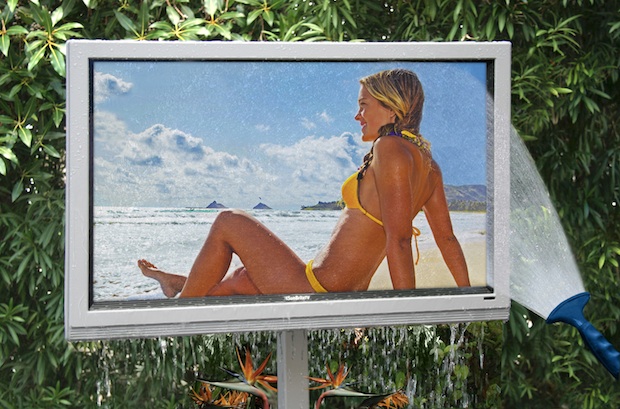
http://news.ecoustics.com/bbs/messages/10381/675318.jpgSunBriteTV has announced the 4630HD 46-inch full-HD 1080p all-weather outdoor LCD HDTV that is designed with outdoor-rated ASA plastic resin and integrated speakers. The resin exterior protects the internal TV components from rain, dirt, insects and other outdoor elements. Built into the exterior is an anti-reflective, impact- and scratch-resistant window that protects the 46" full-HD 1080p LCD screen with 4000:1 contrast ratio. The integrated 20-watt speakers and user-friendly operating controls are sealed against rain and moisture.

The TV's internal climate control consists of a filtered multi-fan airflow system that quietly keeps the unit cool in temperatures up to 122 degrees. A thermostatic heater automatically protects the TV from damage in external temperatures to -24 degrees while at the same time controls humidity and condensation.

SunBriteTV's innovative watertight cable entry system and cable pass-through design ensures quick and easy hook-up to a wide selection of video inputs including four HDMI connections, component, VGA, S-Video, composite, RF and discreet IR control. RS232 is available as an optional item. Model 4630HD ships with SunBriteTV's weather-proof remote control and two-year residential in-factory, parts and labor limited warranty.Price and Availability
The SunBriteTV 4630HD Outdoor LCD HDTV is available immediately for $4,195.

Installation
For optimum viewing, SunBriteTV offers a full complement of ceiling mounts and articulating and tilt wall mounts. For additional placement choices, a deck/planter pole mount is also available. The pole can be set in concrete, or bolted directly to a flat surface such as a patio or pool deck. The pole and supporting flange are made from heavy-gauge aluminum for the 22" and 32" models and zinc plated steel for the 46" and 55" models and are powder-coated to eliminate corrosion. All wall mount and deck planter poles are equipped with stainless steel hardware.

SubBrite Product Line
SunBriteTV's product line offering is divided into two subsets, the Pro-Line series and the HD-Line series. The Pro-Line series includes models 5510HD, 4610HD, 3220HD and 2220HD. These 55-, 46-, 32- and 22-inch models (respectively) are engineered with corrosion-resistant powder-coated aluminum exteriors that protect the inner workings of the TV from rain, snow, dust, insects and extreme temperature ranges. They are equipped with detachable speaker modules that can be removed when the TV is hooked up to an external speaker system. The four models are similar in design and aesthetically work well together in projects that require different size specifications.

The Pro-Line models are ideal for high-end residential and commercial installations where whole-house control systems and networking may be required. To simplify integration, the Pro-Line models feature RS232 and discrete IR input control functions. For networking applications, the Pro Line models can be modified with SunBriteTV's Internal Media Compartment and Cable Kit that customizes the TV to accommodate networking hardware.

    * Model 5510HD, a 55-inch full-HD 1080p with 120Hz refresh rate is offered at $6,795
    * Model 4610HD, a 46-inch full-HD 1080p LCD TV is offered at $4,895
    * Model 3220HD is offered at $2,595
    * Model 2220HD is offered at $2,095

The SunBriteTV HD-Line series includes 32-inch Model 3230HD and 46-inch Model 4630HD. Positioned to target residential installations and budget-minded commercial installations, the HD Line is engineered with outdoor-rated ASA plastic resin and integrated speakers.

    * Model 3230HD is a 32-inch 1080i HD LCD TV at $2,095
    * Model 4630HD, a full-HD 1080p LCD TV, is offered at $4,195

The entire SunBriteTV product line is engineered with the company's proprietary all-weather outdoor feature set that protects the TV from rain, dust, insects and extreme temperatures. They carry an in-factory parts and labor Limited Warranty for residential installations that protects the TV for two full years from the date of purchase.
More aboutSunBriteTV 4630HD Outdoor LCD HDTV

WWE’s True Story of WrestleMania DVD

Diposting oleh nangsa on Jumat, 18 Maret 2011

 The crown jewel of World Wrestling Entertainment is chronicled in the DVD/ Blu-ray release “The True Story of WrestleMania.”

The documentary portion of the release depicts the evolution of the biggest spectacle in sports entertainment.

The beginning of the program focuses on Vince McMahon’s gamble to take WWE to new heights.

Among those reflecting on the early days of WrestleMania was Hulk Hogan, who is currently contracted to Total Nonstop Action Wrestling. Even though this interview probably occurred before signing with TNA, I am glad they gave proper credit to the legendary performer.

Regardless of the opinion one may have for the Hulkster, the integral role he played at the event in its infancy and beyond can’t be denied.

There is also some great archival footage captured on the first disc. Included is behind the scenes shots of WrestleMania IX from Caesars Palace in Las Vegas. It really encapsulated the hard work to orchestrate the pay-per-view spectacle every year.

Viewers get an idea of how hands-on McMahon is as he instructs Shawn Michaels and Lex Luger during preparation for the show.

I believe similar footage aired during a special countdown WWE showed in the hours leading to WrestleMania XVI, but it was nice to see again.

My gripe is the DVD’s assessment of WrestleMania VII as a mediocre show. From an in-ring and emotional standpoint, I think the event delivered with Tito Santana/Michaels, Roddy Piper/Bret Hart and Randy Savage/Ric Flair.

The only other real complaint I have for the documentary is it didn’t touch on Flair’s retirement match against Michaels. Sure “The Nature Boy” is still wrestling today, but the sendoff for Flair was historic and worth noting.

Also on the three-disc set are 11 matches from the “Showcase of the Immortals.” Ricky “The Dragon” Steamboat versus Savage from WrestleMania III still holds up, 24 years later, for its innovation and ring-work. It is still regarded as one of the greatest matches in ‘Mania history, which is a true testament to the two.

Overall the release is highly entertaining and really gets you hyped for WrestleMania XXVII on Sunday, April 3 at the Georgia Dome in Atlanta. The big event will feature Triple H attempting to end the undefeated WrestleMania streak of The Undertaker.

“In my opinion it’s a streak that should not be broken,” Triple H ironically said on the DVD.

I guess “The Game” has since changed his tune.

WWE’s “The True Story of WrestleMania” is available now.
More aboutWWE’s True Story of WrestleMania DVD

iPod Repair Company offers new level of service that's taking the repair market by storm.

Diposting oleh nangsa

 Mission Repair, the Nation's leader in iPod, iPad, iPhone and Laptop Computer Repair services released their exclusive "Got Repair" program announcing Lifetime repairs on many of their services.

"What good is a lifetime warranty on a service if you have to pay full price again if you break you device again?" Asked Ryan Arter, President. "I created the 'Got Repair' program to give customers peace of mind when shopping for their next iPad repair or MacBook repair. I want Mission Repair to be there for the customer if they break or damage the unit again. In most cases, our customers have already had a bad experience with breakage of dropped units - that's why we are in business. Since we see repeat customers, I wanted to design a program for this situation."

Mission Repair's "Got Repair" program can be explained simply:

1. Think of it as "The Real Lifetime Warranty". Check the competition. When they offer lifetime warranties, this doesn't include breakage again on the part you had repaired. What good is a lifetime warranty on a piece of glass that only fails when it breaks? Our "Got Repair" program covers re-repairing damaged glass and screens.

2. Think of it as a "Thank You" for coming back to Mission Repair. If you have your device repaired with us, you already know that it can be broken. And if you should somehow accidentally or intentionally damage it again, we want you to come back to Mission Repair. We would make more money by charging you full price but you may decide not to repair your device more than once. Our "Got Repair" program benefits encourage repeat business with a special thank you to every Mission Repair customer.

3. Think of it as the "New Standard" in which services should be performed. Mission Repair pioneers many programs and we set the standard for the market.

4. Think of it as the opposite of "Insurance". Insurance is just that. You buy insurance "in case" something happens to your unit. If nothing happens, you still pay. Additionally, most insurance plans require a deductible and stringent rules to filing a claim. Our "Got Repair" benefits cost you nothing up front. Rather, we charge a small service fee for any repeat repair. You can have the unit re-repaired once or 1000 times, this service fee will remain the same.

Mission Repair, The Intelligent Choice.

Mission Repair offers "Got Repair" benefits on many of their services. If you use Mission Repair and ever break or damage the part again, they will repair it again - no other business in the market offers this advantage! See the website for details.

About Mission Repair
The 2009, 2010 and 2011 Award Winning iPhone Repair Center. Mission Repair is your choice for full-service iPad, iPod, MacBook and Cell Phone Repair Services. Mission Repair currently offers repair services for iPods, iPhones, Apple Laptop Computers (including MacBook Air, MacBook Pro, MacBook, PowerBook and iBook), gaming consoles (including PSP), Cell Phones with new programs coming online often.

Mission Repair is Accredited though the Greater Kansas City Better Business Bureau and is a Proud Member of the Olathe, Kansas Chamber of Commerce. They employ Apple Certified Macintosh Technicians.

With a 100% customer service mentality, http://www.missionrepair.com is your one-stop repair service center with support for all makes and models of iPods, iPhones and Macintosh Portable Systems, Cell Phones & Gaming Consoles.
More aboutiPod Repair Company offers new level of service that's taking the repair market by storm.

THE KING IS DEAD – LONG LIVE THE KING

Diposting oleh nangsa

It was a sad day in our industry on 31st December 2010, when the British Federation of Audio (BFA) decided to call it a day and close its doors for the last time. Since the 1980s the BFA, and its predecessor the FBA, had been championing the cause for manufacturers of Hi-Fi equipment in the UK. It provided a meeting ground for companies working in the world of Hi-Fi manufacturing, so that they could share ideas, collaborate on projects and receive government funding to visit overseas trade fairs.

But times change, markets shift, companies merge or close, government priorities change and so it was that the BFA took its hard decision. But to coin a phrase, “The king is dead, long live the king”.

BADA, the British Audio-Visual Dealers Association, is still very much alive and kicking and perfectly placed to fill the void left by our friends at the BFA. With a manufacturer membership consisting of around 25 of the industry’s leading producers, in addition to retail members, magazines and PRs, the Association already fulfils many of the activities carried out by the BFA, including regular meetings for discussion, twice-yearly GfK market performance presentations and a discounted corporate health care scheme. Plus, BADA offers extensive training, complimentary Retra membership, a customer-focused website designed to drive traffic to its members and a whole host of other financially advantageous member benefits.

But at the moment BADA is, by the very nature of its original Articles of Association and name, a retailer association, that has in recent years opened up its membership to others within the industry. Manufacturers are currently classified as Associate Members and pay a different rate of membership subscription. This arrangement was fine while the BFA was fulfilling the role of the manufacturers’ trade association, but now things have changed and so must BADA.

We are at a pivotal point as an industry. The end of physical media is in sight, networking skills are now required in order to make systems work, single-brand outlets are beginning to appear (and not just those run by manufacturers – some independents are going single-brand too), internet shopping is here to stay and the overall size of the market is diminishing. Does BADA stand still and continue its work as a retail association, pushing ahead with its standards-based training programmes and supporting its members with a range of benefits? Does it revert to being a small-scale networking club where like-minded people can meet for an informal chat and a social? Or does it look to the future, recognise the changes that are taking place in the home entertainment world and make itself relevant to the industry, as it is now and will be tomorrow?

moving forward
At the recent Annual General Meeting, the chairman of BADA, Simon Byles, outlined his vision for the future of the Association. This followed a presentation made at the summer 2010 meeting, in which we unveiled a road map for BADA’s development. At this point some of the ideas on the plan were purely discussion points, but the demise of the BFA has pushed some of them to the fore and the time is now right to act on them. In his keynote address to the meeting, Simon said “Whilst the closure of the BFA is undoubtedly a sad event for our industry, BADA will be using the next 12 months to reinforce its credentials and to ensure its offering is suitably tailored and appropriate for all sectors of the Hi-Fi and home cinema industry in the UK. We have come a long way in the past few years, successfully casting off many of the preconceptions about what BADA is, and have demonstrated to the industry that we are serious about raising and maintaining standards across the network of independent retailers. It is now time for us to move enthusiastically forwards to the next stage of our development, by turning BADA into the industry’s association with representation for all parties.”

There have been mutterings by some that BADA is a dinosaur, an old men’s drinking club, a clique of old-style Hi-Fi dealers. This couldn’t be further from the truth – the board has worked hard to reposition the Association over the past few years and make it more relevant to the industry. It has a strong and clearly defined purpose to raise and maintain the highest standards across Hi-Fi retail. Testament to this can be seen in the number of high profile manufacturers that have decided to join, because they see the worth in what we are doing. It is these manufacturers who are working hard behind the scenes to assist BADA in its task by helping to develop, host and deliver the acclaimed training programme. Should the Association not therefore recognise this and change its constitution to give equal membership status to all parties within the industry? In fact, should it not revisit its membership criteria in its entirety and examine which sectors of the industry are under-represented and could benefit from membership of a strong, industry-wide trade association?

Coupled with an examination of the key activities and focus of the Association, this is precisely the road upon which we have embarked. BADA will be using the next 12 months to consult and work with the various interested parties to that ensure the Association emerges as a body that fits the requirements of the whole industry. We would welcome your thoughts on what you would want from a trade association - please drop me a line at phil@bada.co.uk.
More aboutTHE KING IS DEAD – LONG LIVE THE KING

FSXFollow 1.41 for iPhone and iPad Turns Device into a Moving Flight Map

Diposting oleh nangsa

PositionGames.com today released FSXFollow 1.41 for iPhone, iPod touch and iPad users. The application turns a user’s iDevice into a moving flight map for FSX, FS2004 and X-Plane simulation flying. Routes are indicated by line on the map and users can check in on the cockpit remotely during flights, as well as capture and publish incoming flight screenshots. FSXFollow also offers easy setup and use, personalized customer care via email and free updates.

Gronau, Germany – Announcing that PositionGames.com, the developers of FSXFollow, has released their latest update for iPhone, iPod touch and iPad users. The application turns a user’s iDevice into a moving flight map for FSX, FS2004 and X-Plane simulation flying. Routes are indicated by line on the map and users can check in on the cockpit remotely during flights, as well as capture and publish incoming flight screenshots. FSXFollow also offers easy setup and use, personalized customer care via email and free updates.

FSXFollow is a terrific resource for users who enjoy simulated flying. The application turns an ordinary iPhone, iPod touch or iPad into a moving map for FSX, FS2004 and X-Plane, allowing for remote following of flight routes and checking in with the cockpit.

No longer are users tied to their desktops to watch their aircraft’s progress, as the portable venue of the app allows for remote access from another room, or anywhere there is an internet connection. This also frees up screen space on a personal computer that would otherwise be taken up for flight following.

All simulated flights are noted on the map as a line, with the map moving to keep pace with the flight. It’s easy to see in a glance, how far along an aircraft is on its route. If users want to check in on the cockpit, they can do that, too. With a touch of a button, they can change views and even save or publish the incoming screenshots to their blog or website.

These are some of the features offered in FSXFollow:
* Easy-to-use interface
* Universal app – works on iPhone, iPod touch, iPad
* Connects to FSX, FS2004 and X-Plane
* PC Client provided free
* Map supports drag to pan and pinch to zoom.
* Follow flight on the go, not limited to home network
* Option to save an incoming screenshot
* NDB and VOR beacons are made visible on the map for easy navigation.
* Route is shown as a line on the map
* Option to publish a screenshot
* Easy setup, no entering of ip address required
* No local network needed
* Option to transfer screenshots to iPad, iPhone and iPod touch (FSX only).
* Option to automatically snap to optimal zoom level
* Free updates and additional features as they become available
* Personalized and friendly customer support via email

FSXFollow is comprised of an easy-to-use format and setup that has users up and running quickly. If they do have questions, PositionGames.com is providing personalized and friendly customer email support for the app, which everyone is invited to use. The developer is also offering free updates and additional features as they become available.

Device Requirements:
* iPhone, iPod touch and iPad
* Requires iOS 3.0 or later
* 9.6 MB

Pricing and Availability
FSXFollow 1.4 is only $5.99 (USD) and available worldwide exclusively through the App Store in the Games category. Promo codes are available for qualified reviewers. Please specify the website or blog you represent when making your request.

FSXFollow 1.41: http://www.PositionGames.com/fsxfollow/
Purchase and Download: http://itunes.apple.com/us/app/fsxfollow/id377912125?mt=8
Media Assets: http://s1224.photobucket.com/albums/ee369/hieronymus100/

Based in Europe, PositionGames.com is a company of software developers specialized in add-ons for Microsoft Flight Simulator for Windows. FSXFollow is one example of the flexible, high quality and fun applications from PositionGames.com. Other products are FSXControl and FSXPad. Copyright (C) 2011 Mobile-App-Marketing-Makeover. All Rights Reserved. Apple, the Apple logo, iPhone and iPod are registered trademarks of Apple Inc. in the U.S. and/or other countries.
More aboutFSXFollow 1.41 for iPhone and iPad Turns Device into a Moving Flight Map

Apogee Announces Mike, the Studio Mic for IOS

Diposting oleh nangsa on Sabtu, 12 Maret 2011

Looking to capitalize on the interest surrounding Garageband for the iPad, Apogee Electronics has announced the upcoming release of Mike, a studio-grade microphone for recording audio on the iPad, iPhone and iPod Touch.

Mike is specifically designed to record vocals and acoustic musical instruments, Apogee says. It can also record voiceovers, interviews or podcast recordings with what the company bill as "pristine sound quality" thanks to PureDigital technology.

At 4.5 inches tall, the Apogee is about the size of an iPhone or iPod touch. It doesn't require any configuration, and it features a multicolor LED for status indication and input level monitoring. Mike comes with its own mic clip and desktop stand.

Some details left out of Friday's announcement--when Mike will be available and how much the microphone will cost.
More aboutApogee Announces Mike, the Studio Mic for IOS

Two essential Bluetooth accessories for the iPod nano 6G

Diposting oleh nangsa

http://i.zdnet.com/blogs/i10s-sony-ericsson-hbh-is800-bluetooth-ogrady.jpg’ve been on vacation this week in Lake Tahoe with my family and wanted to share two of my favorite iPod nano 6G accessories. I like to listen to music when I snowboard, in fact, I have to listen to music when I ride, it’s an essential part of the experience for me. But snowboarding isn’t a prerequisite, Bluetooth earbuds are great for any time you want to listen to your iPod without a tangle of wires around your body. I use this same setup at the gym and for doing yard work at home.

Here are my two must-have iPod nano accessories:

    * i10s Bluetooth adapter ($45) - Since the iPod nano 6G doesn’t have Bluetooth, a dongle is your only option. While dozens of choices exist, the i10s BT adapter is the smallest of the lot. When you’re rocking the world’s smallest iPod, you don’t want a big horsey adapter jutting out of the side. At about two-thirds the size of Sony’s BT adapter, the i10s is the perfect fit. The i10s is zero-config and auto-pairs when it’s powered up. It also has pretty good range, although I mostly used mine about a foot away from the receiving headphones. The i10s looks like it’ll be the perfect fit for my LunaTik watch kit when I get home.

    * Sony Ericsson HBH-IS800 Bluetooth earbuds ($119) - For BT earbuds I took the advice of my podcasting co-host (@parkerdigital) and purchased a set of HBH-IS800. They’re absolutely tiny and don’t need to go over the top of your head. These buds are fantastic because you can’t tell that you’re wearing them (they connect with a small cable that goes around the back of your neck.) They paired flawlessly with the i10s adapter and were able to make it through a 6-hour ski day on a charge — barely. They could be a little louder and fit isn’t perfect (mine fall out now and again) but I think that this can be addressed with using one of the larger pairs of flanges included in the package.

Sure, I could probably ride with my iPhone and the HBH-IS800’s, but I generally prefer a dedicated audio device like the nano when riding. This allows me to leave the iPhone in the car, or dedicate it to more important things like running the Ski Tracks app (more on that in another post).

What’s your iPod > sports combination?
More aboutTwo essential Bluetooth accessories for the iPod nano 6G

How To: Wipe your old iPad/iPhone/iPod touch ready for resale

Diposting oleh nangsa on Jumat, 11 Maret 2011

I’ve been asked several times over the past few days about how to wipe an iPad/iPhone/iPod touch ready for resale. Instead of repeating myself over and over, I thought that a post was in order.

It’s in fact dead easy …

    Tip: Remember to do a backup via iTunes first … there’s no going back from a wipe!

Settings > General > Reset > Erase All Content and SettingsThe same process works for iPad, iPhone and iPod touch.

    Tip: Make sure your iPad is plugged into a power source while erasing.

Now, the security conscious out there will be keen to know how the erasure is carried out. To satisfy you folks, I found this on the Apple website:

    When you opt to “Erase All Content and Settings,” the process can take up to several hours. The time this process takes will vary by device:

    Devices that support hardware encryption: Erases user settings and information by removing the encryption key to the data. This process takes just a few minutes.
    Devices that overwrite memory: Overwrites user settings and information, writing a series of ones to the data partition. This process can take several hours, depending on the storage capacity of your iPhone or iPod touch. During this time, the device displays the Apple logo and a progress bar.

 iPhone 3GS, iPhone 4, iPad, and iPod touch 3rd and 4th gen support hardware encryption.
More aboutHow To: Wipe your old iPad/iPhone/iPod touch ready for resale